The vCard specification has a PHOTO field. You can put an image straight into a contact card, encoded as text, and a QR code can carry it. People ask for this constantly, usually for a business card or a conference badge, and most answers online are either "yes you can" or "no you cannot", with nothing behind either.
So we measured it.
The short version: a 32 pixel thumbnail, smaller than an emoji, takes a vCard code from 45 by 45 modules to 125 by 125. That needs about 53 mm of printed width, which is wider than a business card is tall. A photo at any sensible size does not fit in a QR code at all.
The short answer
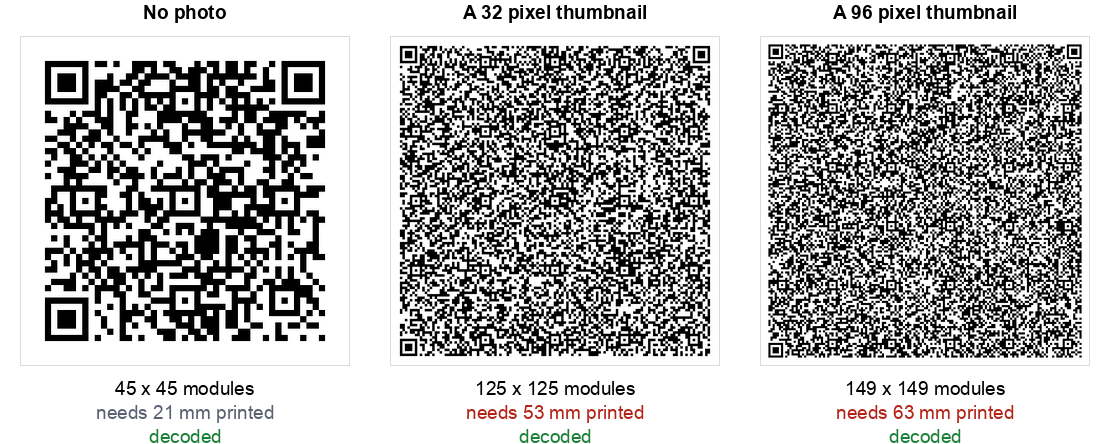
What a photo costs, measured
| The vCard contains | Chars | Grid | Min printed width | Decoded |
|---|---|---|---|---|
| Name, phone, email, company | 121 | 45 x 45 | 21 mm | Yes |
| + a 32 px thumbnail | 1,077 | 125 x 125 | 53 mm | Yes |
| + a 48 px thumbnail | 1,165 | 129 x 129 | 55 mm | Yes |
| + a 64 px thumbnail | 1,301 | 137 x 137 | 58 mm | Yes |
| + a 96 px thumbnail | 1,641 | 149 x 149 | 63 mm | Yes |
| + a 150 px photo | 2,589 | Does not fit in a QR code at all | ||
Every one of those that fits does decode, on a clean digital image at full resolution. That is worth saying plainly, because the failure here is not "the code is broken". The code is perfectly valid. The problem is entirely about what happens when you print it.
A printed QR module needs roughly 0.4 mm before ink spread and camera focus start working against it, and every code needs a four module quiet zone on each side. So a 125 by 125 grid needs (125 + 8) x 0.4, which is 53 mm. A business card is 55 mm tall. You would be printing a code that fills the entire card, for a thumbnail nobody can see.
Put that next to the alternative. The same contact details with no photo fit in 21 mm, and a link to a contact page fits in under 15 mm. We worked through those numbers in our business card guide. A photo costs you more printed area than everything else on the card combined.
The hard ceiling nobody mentions
The 150 pixel row is not a judgement call. It is a hard limit of the format.
QR codes stop at version 40, which is a 177 by 177 grid, and that is the largest QR code that exists. Its capacity depends on the error correction level:
| Error correction | Maximum bytes at version 40 |
|---|---|
| L, lowest | 2,953 |
| M, the common default | 2,331 |
| Q | 1,663 |
| H, highest | 1,273 |
Our 150 pixel photo produced a 2,589 character vCard. At level M that is past the ceiling, and the encoder refuses: there is no version 41 to grow into. You would have to drop to level L, giving up almost all error correction, to fit it into a 177 by 177 code needing about 74 mm of print.
At level H, the level you would want for anything carrying a logo or destined for wear, the whole budget is 1,273 bytes. That is smaller than our 48 pixel thumbnail. A photo and error correction are close to mutually exclusive.
Why a photo is so expensive
Two multiplications stack up, and that is what surprises people.
First, an image has to be turned into text to live inside a vCard, using base64. That encoding is about a third larger than the raw file. A 750 byte JPEG becomes roughly 1,000 characters.
Second, a QR code grows in fixed version steps, and each step adds four modules to every side. Going from 121 characters to 1,077 is not a small nudge along a curve, it is roughly twenty version steps, and the printed area grows with the square.
So a thumbnail that is 1 KB as a file, which sounds like nothing, is eight times the entire rest of the contact card once encoded, and the code that carries it has almost eight times the area.
What to do instead
Everyone asking this wants the same outcome: the person who scans your card ends up with your face next to your name in their phone. There are two honest ways to get that, and neither involves putting the image in the code.
- Point the code at a contact page you control. The page can show the photo at any size and offer a downloadable contact file that includes it. The code itself stays under 15 mm because it only carries a short URL. This is the approach we would use for anything printed.
- Use a plain vCard code and let their phone find the photo. Save a contact with an email address and most phones will pull a profile picture from the linked account or from the person's own address book sync. You get the photo without paying for it in millimetres.
There is a third option people try that we would avoid: putting your photo next to the code on the card, and a plain vCard inside it. That is fine, and it is what most well designed cards already do. It just is not the same thing as a photo in the code, and it works precisely because the photo is not in the code.
Our vCard generator deliberately does not offer a photo field, for the reasons above. If you want to test any code you have made, including one from another tool with a photo in it, our stress test will show you how much blur and how small a print it survives.
How we tested this
- The same contact card throughout, name, mobile, email and company, so the only variable was the photo.
- JPEG thumbnails at five sizes, base64 encoded into the vCard
PHOTOfield exactly as the format specifies. - Error correction level M, the common default, except in the capacity table which lists all four.
- Grid sizes read from the encoder, so they are exact, and the 150 pixel case is the encoder refusing rather than our judgement.
- Every code decoded back with jsQR and compared character by character against the input. All the ones that fit matched.
- Printed widths calculated at 0.4 mm per module plus the quiet zone.
Two honest limits. The 0.4 mm floor is a common working figure for laser printing rather than something we measured on a press. And our test images are synthetic gradients rather than real portraits, so a real face may compress slightly better or worse, which moves the character counts by a little and the conclusion by nothing.
The summary
You can put a photo in a vCard QR code. The specification allows it, the encoder will do it, and the result decodes. It is still the wrong thing to do, because the code you get needs more printed space than the card it was meant to go on.
A 32 pixel thumbnail costs you 32 mm of extra printed width. Point the code at a page with the photo on it instead, and keep the code under 15 mm.
If you want the contact card itself, our vCard QR code generator builds one from the fields that are worth carrying, and our business card guide has the millimetre by millimetre breakdown of what each field costs.